Disclosure Some links on this page are affiliate links. If you book through them we earn a small commission, at no extra cost to you — it is what keeps this guide free and independent. How we make money.
Crete's best-known walk is closed for half the year, and a lot of visitors conclude that winter hiking here is off. The opposite is closer to the truth: for everything below the snow line, winter is the good season. What changes is which routes are sensible, and one specific risk that deserves respect rather than caution.
Quick Answer
The Samaria Gorge is closed from about November to early May. Imbros Gorge is the standard winter substitute — lower, shorter, privately managed, open in normal conditions. Agia Irini, the Akrotiri peninsula paths and the Sfakia coastal path also stay walkable. Winter is genuinely the better hiking season at low altitude: 15–18°C, green landscape, empty trails. The two rules that matter: never enter a gorge when heavy rain is forecast or has just fallen, and be off the hill by 16:30 in midwinter.
Why Samaria Closes — and Why It Matters Beyond Samaria
The Samaria Gorge shuts for winter, generally from the start of November to early May, with exact dates set each year by the national park. The reason is worth understanding rather than filing as bureaucracy, because it applies to every gorge on the island.
A Cretan gorge is a drainage channel. It is dry for most of the year because it rains for a few months, not because water never runs there. When heavy rain falls on the White Mountains, that water arrives in the gorge below fast, and it can arrive when the sky above you looks fine. Add saturated ground loosening rock on 300-metre walls, and a 16km route with no exit points becomes a place you cannot get out of quickly. That is the closure.
The generalisable rule: a gorge is not somewhere to be when heavy rain is forecast, has recently fallen, or is falling in the mountains upstream — regardless of which gorge, and regardless of whether it is officially open. Imbros is open in winter, and Imbros is still a riverbed.
Six Routes That Stay Open
All within reach of Chania, ordered roughly from most to least reliable in poor weather.
Imbros Gorge
The standard winter substitute for Samaria, and a good walk in its own right rather than a consolation. Lower, shorter, privately managed, and open year-round in normal conditions.
Watch for: It is still a riverbed. After heavy rain it can run with water and management may close it for the day — check locally before driving out.
The Akrotiri peninsula paths
Low, coastal, close to the city and walkable in almost any winter weather. The routes around the monasteries — Agia Triada, Gouverneto — and down toward Stefanou (Seitan Limania) are the reliable bad-weather option.
Watch for: The descent to Seitan Limania is steep and slippery when wet. The beach itself is a summer proposition; the walk is the winter one.
Agia Irini Gorge
Lower and gentler than Samaria, wooded, and generally open through winter. A genuine gorge walk without the altitude or the closure.
Watch for: Conditions vary and it can close after storms. Confirm before setting out — this is not a trail to gamble a two-hour drive on.
The Sfakia coastal path
Sea-level, spectacular, and one of the few walks that is arguably better in winter — no heat, no crowds, and the Libyan Sea in its dramatic mood.
Watch for: Exposed in places. Winter storms make sections genuinely unpleasant, and the ferry that would normally bail you out runs a reduced timetable.
Therisso Gorge
Not a long hike but the easiest wild landscape to reach from the city — a dramatic road through a gorge to a village of tavernas. Ideal for a half-day when the weather is marginal.
Watch for: The road floods in places after heavy rain.
Olive-grove and village walks inland
The most underrated winter walking on the island. Green, gentle, dotted with villages and kafeneia, and at its best exactly when the mountains are not.
Watch for: Waymarking is poor to nonexistent. Download offline maps.
Winter Trailheads Are a Car Problem, Not a Fitness One
Every route above except the Akrotiri paths needs a drive. The seasonal buses that serve trailheads in summer do not run in winter, and the year-round KTEL services do not go where the walking is. A hire car in the off-season is also the cheapest it gets — see our winter driving guide for the road conditions to expect.
Winter Safety, Specifically
Not generic advice — the things that actually differ between a Cretan summer walk and a Cretan winter one.
- Flash flooding is the serious risk. Covered above, and worth repeating because it is the one that kills people. Rain upstream, not overhead, is what matters. If in any doubt, walk the coast instead.
- Daylight is short and the end comes fast. Sunset around 17:00–17:30 in December. Plan to finish by 16:00, and carry a head torch even on a walk you expect to complete in daylight.
- Wet limestone is genuinely slippery. Cretan rock polishes smooth on well-used paths and becomes treacherous in the wet. This is the most likely way to hurt yourself, and it is a footwear problem.
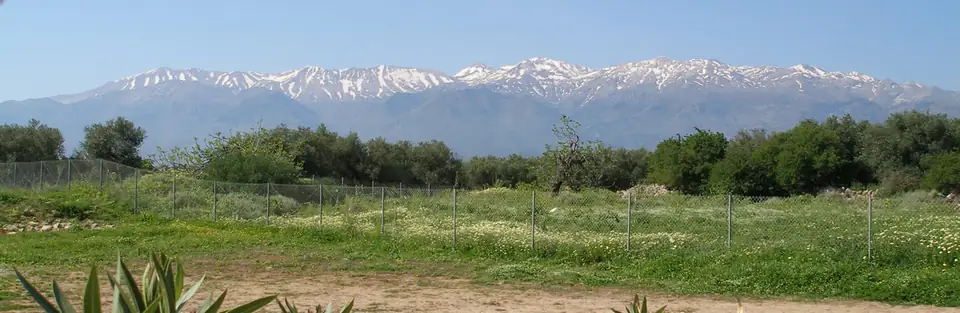
- The snow line is real and it is low. Above roughly 1,000m in the Lefka Ori, winter walking becomes winter mountaineering, needing equipment and experience most visitors do not have. The high plateaus and peaks are not casual winter objectives.
- Villages close. The taverna you were counting on for lunch may be shut. Carry food and water rather than planning around a resupply.
- Phone signal is patchy in gorges year-round. Tell someone your route.
What to Carry
Cretan winter hiking is not an equipment-heavy activity at low altitude, and you do not need mountaineering kit for any route on this page. What you do need:
- Boots with genuine grip, and preferably waterproof. The single most important item, because wet polished limestone is the real hazard.
- A proper waterproof shell. Cretan winter rain arrives hard and briefly rather than as drizzle.
- Layers. 16°C in the sun on a coastal path and 8°C in a shaded gorge with wind are the same afternoon.
- Head torch, for the reason above.
- Offline maps. Waymarking on the village and olive-grove routes ranges from sparse to absent, and signal is unreliable. Download the area before you leave the city.
- More water than the temperature suggests. Cool weather masks how much you are using.
Getting to the Trailheads
This is the genuine winter obstacle, and it is logistical rather than physical. In summer, seasonal buses and tour operators serve the popular trailheads daily. In winter both largely stop: KTEL runs its reduced timetable on the main intercity routes, and the services that would drop you at a gorge mouth do not operate.
Which leaves three options. Hire a car — the cheapest it is all year, and the answer for most people; our winter car rental guide covers the road conditions. Book a guided walk, which includes transport and solves the problem entirely, though winter programmes are reduced and need booking ahead. Or stay on the Akrotiri routes and the city-adjacent walks, which are genuinely good and need no vehicle at all.
For the wider picture of walking here across the seasons, see our hiking in Chania guide, and for the gorge itself in season, the Samaria Gorge guide.
Frequently Asked Questions
Can you hike the Samaria Gorge in winter?
No. It is closed by the national park, typically from the start of November to early May, with exact dates set annually. The closure is not caution: the route follows a riverbed that becomes a genuine flash-flood channel after heavy rain, and rockfall risk rises through the wet months. Imbros Gorge — lower, shorter, privately managed — is the usual winter substitute.
Is winter a good time to hike in Crete?
For everything below the snow line, arguably the best. 15–18°C is far more comfortable than the 35°C-plus that makes August walking dangerous, the landscape is green rather than burnt, water runs where it is dry all summer, and the trails are empty. The constraints are shorter daylight, rain, and the high routes and Samaria being out of bounds.
Which gorges in Crete are open in winter?
Imbros is the reliable one — lower, shorter and privately managed rather than national-park run. Agia Irini generally stays open too. Both can close temporarily after heavy rain, so confirm locally before a long drive. Samaria is closed all winter. As a rule, the lower and shorter the gorge, the more likely it is walkable in February.
Is it safe to hike in Crete in winter?
On low and coastal routes, yes, with normal precautions. The specific winter risks: flash flooding in any gorge after heavy rain, which can arrive from rain falling upstream rather than overhead; short daylight, dark by around 17:00–17:30 in December; slippery wet limestone; and snow above roughly 1,000m, where the White Mountains become winter mountaineering rather than hiking. Check the forecast, start early, and treat any gorge as off-limits when heavy rain is forecast or has just fallen.
Do you need a guide for winter hiking in Crete?
Not for low-level and coastal routes. A guide earns their fee in two cases: anything in the mountains in winter conditions, where snow and navigation make it a different activity; and if you have no car, since winter bus timetables do not reach most trailheads and a guided walk includes transport. Guided walking runs year-round on a reduced winter programme, so book ahead.
More winter planning: Winter in Crete hub · Winter car hire · The Cretan winter table · Hiking in Chania (all seasons)