Disclosure Some links on this page are affiliate links. If you book through them we earn a small commission, at no extra cost to you — it is what keeps this guide free and independent. How we make money.
Most visitors to Chania never cross the mountains. That is the single best reason to do it.
Quick Answer
Crete's south coast is the island's quiet half — no large resorts, the warmer Libyan Sea, and the White Mountains dropping straight into the water. Six villages matter in the west: Chora Sfakion, Loutro, Agia Roumeli, Paleochora, Sougia and Frangokastello. Two of them — Loutro and Agia Roumeli — have no road access at all and are reached only by boat or on foot. Everything is 1–2 hours from Chania over winding mountain roads. Give it at least two nights; a day trip barely scratches it.
How the South Coast Differs From the North
Crete's north coast carries the airports, the ports, the cities and effectively all of the large-scale tourism. The south has the mountains in the way — and that geography has kept it genuinely different, not just marketed as such.
- No large resorts. The settlements are villages, and several are small enough to walk end to end in five minutes.
- The Libyan Sea is warmer. Noticeably so by late spring, and it stays swimmable later into autumn than the north coast does.
- Roads are the exception, not the rule. Two of the six villages below have no road at all. That is not a quirk; it is what the gorges do to road-building.
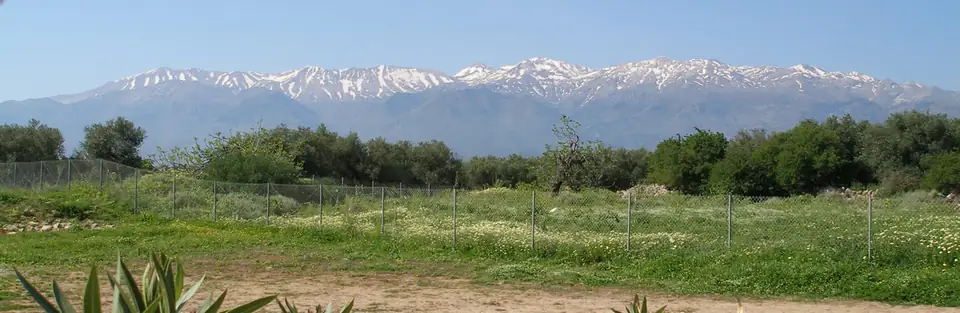
- The scale is different. The White Mountains rise to over 2,400m and fall almost directly into the sea. There is no coastal plain to soften it.
- Less to do, deliberately. If you want nightlife and organised activity, stay north. If you want to swim, walk, eat and read, come south.
The Six Villages Compared
| Village | Road access? | From Chania | Best for |
|---|---|---|---|
| Chora Sfakion | Yes | ~1h15–1h30 | Ferry hub, a base with a car |
| Loutro | No — boat or foot | Boat from Chora Sfakion | Total quiet, no cars at all |
| Agia Roumeli | No — boat or foot | End of the Samaria Gorge | Gorge walkers, one night |
| Paleochora | Yes | ~1h30 | Most choice of rooms and tavernas |
| Sougia | Yes | ~1h15 | Low-key, pebble beach, few crowds |
| Frangokastello | Yes | ~1h30 | Families — shallow water, castle on the sand |
Chora Sfakion
The road ends here, and the boats start. A small working harbour under enormous cliffs, and the natural hub if you are arriving by car — you park, and the ferry takes you along the coast to places the road cannot reach. Sfakia has a fierce reputation and a genuinely distinct local culture; the food is some of the best on the island.
Loutro
The one everyone remembers. A crescent of white buildings around a blue bay, with no road in — you arrive by ferry from Chora Sfakion in about 30 minutes, or on foot along the coastal path. No cars, no scooters, no through traffic. There is nothing to do, which is the entire point. Covered in depth in our Loutro & Sfakia guide.
Agia Roumeli
Where the Samaria Gorge reaches the sea. Also road-less: most people arrive having just walked 16km down the gorge, and leave by ferry the same afternoon. Staying the night — rather than joining the scramble for the last boat — is an underrated move.
Paleochora
The largest of the six, on a peninsula with a sandy beach on one side and pebbles on the other, and a Venetian castle ruin above. The widest choice of rooms, tavernas and onward ferries, and the best base if you want a south-coast trip that does not require careful planning.
Sougia
A long pebble beach, a handful of tavernas, and very little development — the result of a local decision decades ago to keep it that way. The drive down from the north is spectacular. Good for walkers: the Agia Irini gorge comes down nearby, and the coastal path to Agia Roumeli starts here.
Frangokastello
A 14th-century Venetian fortress standing directly on the sand, with wide shallow water that warms up early. The most family-friendly of the six by a distance, and the flattest — most of the south coast is anything but.
Where to Stay on the South Coast
Rooms here are small, family-run and limited in number — Loutro in particular sells out months ahead for July and August. Our village-by-village breakdown covers who each place suits.
The Coastal Ferry Is the Local Road
This is the part people miss, and it changes how you plan.
ANENDYK runs the coastal line connecting Paleochora – Sougia – Agia Roumeli – Loutro – Chora Sfakion, and on to Gavdos, the southernmost point in Europe. It is not a tourist excursion; it is the public transport that holds this coast together, because the mountains make an east–west road impossible.
- Season: broadly April to October, with the fullest service in high summer.
- Weather: strong winds cancel sailings. This is common enough that you should never plan a tight onward connection off a south-coast ferry.
- Tickets: Anendyk offices in Paleochora and Chora Sfakion, plus smaller outlets in Sougia, Agia Roumeli and Loutro in high season.
The practical consequence: a car and the ferry do different jobs. Drive to a road-accessible village, park, and use the boat for the rest. Trying to do everything by car simply does not work here.
Getting There From Chania
By car — 1 to 2 hours depending on the village, over mountain roads that are well surfaced but winding, with real gradients and a few hairpin descents. Allow more time than the distance suggests, and consider something with a bit more engine than the cheapest economy category. Full detail in our south Crete road trip guide.
By bus — KTEL runs from Chania to Paleochora, Sougia, Chora Sfakion and Frangokastello. Frequencies are seasonal and thin outside summer, so check the timetable before relying on it. For the two road-less villages the bus gets you to the ferry, which is all it needs to do.
By tour — day trips run from Chania, most commonly combining the Samaria Gorge with the ferry from Agia Roumeli to Chora Sfakion. Good for a taste; not a substitute for staying.
Renting a Car for the South Coast
The mountain roads reward a car with a bit more power than the base economy class. LocalRent compares Cretan companies alongside the international brands, so you can see what you're actually getting. From €18/day.
How Long to Give It
- A day trip — possible, and the standard version is the Samaria Gorge finishing with the ferry to Chora Sfakion. You will see the coast from a boat and eat one lunch. Fine, but it is a gorge trip, not a south coast trip.
- Two nights — the minimum that actually works. One road-accessible base, one boat trip out to Loutro, and enough time to stop moving.
- Three to four nights — the sweet spot. Two villages, the ferry between them, a gorge walk, and several unhurried swims. See the 3-day road trip.
- A week — add Gavdos, which needs the better part of two days on its own.
When to Go
May–June and September–early October are the best windows: the sea is warm, the ferries are running, the gorges are open, and the villages are busy without being full.
July–August works but rooms are scarce and expensive — Loutro especially books out months ahead — and the walking is genuinely hard in the heat.
November–March is a different proposition. The coastal ferries largely stop, many rooms and tavernas close, and the road-less villages become very hard to reach. Beautiful, but not a casual trip. See best time to visit.
Frequently Asked Questions
Is the south coast of Crete worth visiting?
Yes, if you want the quieter half of the island — no large resorts, warmer swimming in the Libyan Sea, and mountains falling straight into the water. It's less convenient than the north coast, and that's precisely the point.
Do you need a car for the south coast?
It helps a lot but isn't essential. Paleochora, Sougia, Chora Sfakion and Frangokastello are road-accessible and served by KTEL buses. Loutro and Agia Roumeli have no roads at all, so a car is useless for those two — you take the ferry.
Which south Crete villages have no road access?
Loutro and Agia Roumeli. Both are reached only by ferry or on foot. Loutro is about 30 minutes by boat from Chora Sfakion.
How does the south coast ferry work?
ANENDYK runs the line linking Paleochora, Sougia, Agia Roumeli, Loutro, Chora Sfakion and Gavdos, roughly April to October, weather permitting. Strong winds do cancel sailings, so never plan a tight onward connection off one.
What about Matala — is that the south coast too?
Yes, but a different part of it. Matala is in the Heraklion region, about 70km south-west of Heraklion and roughly 2.5 hours from Chania — a separate trip rather than an add-on to the villages above. Our sister site covers it.
Plan the Trip