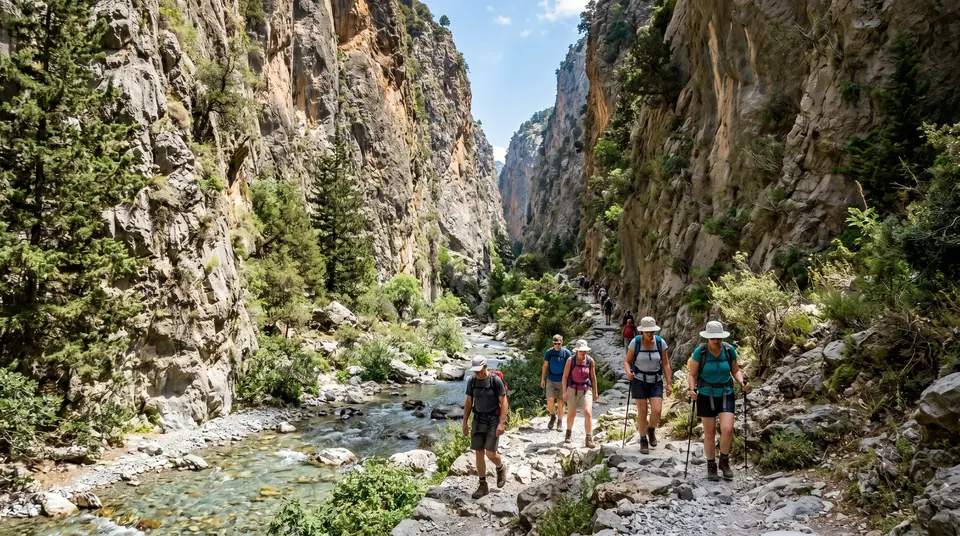
The Samaria Gorge hike is the crown jewel of outdoor adventure in Crete — a dramatic 16 km trail through one of Europe's most spectacular gorges, carved over millennia by the White Mountains into the island's rocky heart. If you are planning a trip to Chania, this is the one full-day excursion that belongs on every itinerary, whether you are a seasoned trekker or a first-time hiker lacing up boots in the Greek sunshine.
The trail descends from the mountain village of Xyloskalo at 1,250 metres elevation all the way down to the Libyan Sea at Agia Roumeli — a journey through ancient pine forest, past abandoned stone villages, through the legendary Iron Gate where the gorge walls close to barely two metres wide, and finally onto a sun-bleached coast where a cold Mythos beer on a taverna terrace feels very well earned.
This guide covers everything you need: transport from Chania, the route broken down section by section, what to pack, costs, the best months to go, and whether a guided tour is worth it. All the facts below have been verified against official park information and first-hand hiking accounts.
At a Glance
Getting to Samaria Gorge from Chania
The gorge entrance is at Xyloskalo, roughly 42 km south of Chania city centre in the Omalos plateau. You have two main ways to get there: the public bus or a guided day tour. Both are reliable; the choice comes down to flexibility versus convenience.
Option 1: Public Bus (KTEL)
KTEL buses depart from Chania Bus Station on Kidonias Street daily during the season. The first bus leaves around 6:15 am and gets you to Xyloskalo by 7:30 am — ideal timing to beat the crowds and the midday heat. The journey takes approximately 1 hour 15 minutes on winding mountain roads.
| 🚌 Bus: Chania → Xyloskalo | €8.50 |
| 🎟️ Park Entrance Fee | €10 (under 18 & over 65 free) |
| ⛴️ Ferry: Agia Roumeli → Hora Sfakion | €12.50 |
| 🚌 Bus: Sfakion → Chania | €11.00 |
| Total (Self-Guided) | ~€42–47 |
Important: Bring at least €37 in cash. ATMs are scarce once you leave Chania, and neither the ferry nor the park entrance typically accepts cards reliably. A small buffer covers snacks and drinks at Agia Roumeli at the end.
Park hours: Open 1 May – 31 October, 7am to 4pm. Last entry for the full hike is 1pm.
Option 2: Guided Day Tour from Chania
Guided tours typically depart Chania at 6:00–6:30 am and handle all transport logistics — outbound bus, park entrance, return ferry, and the bus back to Chania. A licensed English, Greek, and German-speaking guide accompanies the group, provides briefings at key points along the route, and ensures you catch the right ferry. Tours cost approximately €30 per adult and €15 for children aged 4–12.
Book a Guided Samaria Gorge Tour
From €30/adult · Includes transport, park entry & guide · English/German/Greek
If you prefer to browse multiple operators and compare reviews, GetYourGuide's Chania tours page lists several Samaria Gorge day trips with verified traveller ratings. For those who prefer the freedom of their own wheels on the drive south, a rental car from Chania lets you set your own start time and return at your own pace — just note that parking at Xyloskalo is limited in peak season, and you will still need the ferry to return (your car stays at the top).
The Hike — What to Expect
Samaria Gorge is almost entirely one-way and downhill, which sounds like a gift — and for the most part it is. But the first four kilometres are a relentless rocky descent on a zig-zag path cut into the cliff face, and by the end your knees will remember every step. Here is the route broken into four natural stages:
Xyloskalo — The Wooden Staircase (km 0–4)
The trail begins with a steep, switchbacked descent known as the Xyloskalo — Greek for "wooden staircase". From the entrance gate at 1,250 metres, you drop sharply through fragrant Cretan pine and cedar forest. The path is rocky and uneven; trekking poles earn their place here. By the time the gradient eases at around 4 km you will have shed roughly 900 metres of altitude. Views back up towards the White Mountains are extraordinary on clear mornings.
The Valley Floor and Samaria Village (km 4–9)
Once the descent moderates, the gorge floor opens into a wide, wooded valley. This is where the pace becomes pleasant — a gentle walk through oleander and plane trees beside the seasonal Tarraios stream. At around km 7, you pass through the abandoned stone village of Samaria, which was inhabited until 1962 when the gorge became a national park. There are basic toilets and water spigots here — refill your bottles. Keep an eye out for Kri-Kri, the endemic Cretan wild goat; the gorge is one of its last refuges.
The Iron Gate — Sideroportes (km 11)
This is the moment every hiker anticipates. At the 11 km mark, the gorge walls close in to a staggering 2–3 metres wide while rising 300 metres overhead — a natural cathedral of rock that squeezes you into single file. The path here runs directly through the streambed; in early May there may be shallow water to wade through. Most hikers spend several minutes here simply standing, looking up, and taking photographs. It remains one of the most dramatic natural sights in the whole of Greece.
Old Agia Roumeli to the Coast (km 11–16)
After the Iron Gate, the gorge widens and the final five kilometres are the most forgiving — flat gravel and sandy riverbed walking through the gorge's southern mouth. You pass through the hamlet of Old Agia Roumeli before reaching the park exit gate, where a ranger stamps your entrance token. From the gate it is a further 15-minute walk on a paved path to the seaside village of Agia Roumeli on the Libyan Sea. Ferries run from here to Hora Sfakion, from where a KTEL bus returns to Chania.
Compare Samaria Gorge Tours on GetYourGuide
Read verified reviews · Multiple departure times from Chania · Free cancellation options
Samaria Gorge is one of several spectacular day trips from Chania that make this region so rewarding for active travellers. After the hike you will have well and truly earned a rest — see our guide to the best beaches near Chania for the next day's recovery plan.
🪂 Before You Leave the South Coast
The ferry from Agia Roumeli stops at Hora Sfakion — and just a short drive inland from there is the Aradena Bridge, where you can bungee jump 138 metres into one of Crete's most dramatic gorges. If you're doing the south coast anyway, this is the natural add-on for thrill-seekers.
Book Aradena Bridge Bungee Jump →What to Pack for Samaria Gorge
Packing right makes the difference between a triumphant hike and a miserable one. The gorge is remote — there are no shops, cafés, or first-aid stations between the entrance and the exit. Here is what every hiker should bring:
Essentials (Non-Negotiable)
- Sturdy ankle-support hiking boots
- At least 2–3 litres of water
- Packed lunch and energy snacks
- Trekking poles (knee protection on descent)
- Sun hat and UV sunglasses
- High-SPF sunscreen
- Cash (minimum €37 for transport + entry)
- Small backpack (20–25 litre)
- Blister plasters and basic first aid
- Phone with offline maps downloaded
Highly Recommended
- Lightweight rain jacket (spring)
- Trekking socks (anti-blister)
- Electrolyte tablets or sachets
- Swimwear (for the beach at Agia Roumeli)
- Small microfibre towel
- Knee supports or compression sleeves
What NOT to bring: Heavy luggage, casual trainers or sandals, sandals of any kind, or anything you wouldn't want to carry 16 km. Lockers are not available at the trailhead. Leave the big bag at your hotel in Chania.
Best Time to Hike Samaria Gorge
The gorge is open from 1 May to 31 October only — it closes over winter due to flash flood risk from the White Mountains snowmelt. The table below gives an honest month-by-month breakdown to help you plan. For a broader picture of Cretan weather and crowds, see our best time to visit Chania guide.
| Month | Temp at Gorge | Crowds | Rating | Notes |
|---|---|---|---|---|
| May | 18–24°C | Moderate | Best | Wildflowers, stream running, green gorge. Perfect conditions. |
| June | 24–30°C | Growing | Good | Warm but manageable. Start no later than 7am. |
| July | 32–38°C | Very High | Avoid | Extreme heat in the valley floor. Risk of heat exhaustion. |
| August | 34–40°C | Maximum | Avoid | Busiest month; brutal heat. Only for very early risers. |
| September | 26–32°C | Moderate | Best | Sea still warm. Crowds thin. Excellent all-round. |
| October | 20–26°C | Low | Best | Atmospheric, quiet, autumn colours. Last weeks of season. |
| Nov–Apr | N/A | — | Closed | Park closed due to flood risk from mountain snowmelt. |
Our recommendation: Target early October if you want the gorge almost to yourself in cool conditions, or early May for lush green scenery with the Tarraios stream in full flow.
Guided Tour vs Self-Guided: Which Is Right for You?
Both options are popular for good reason. The right choice depends on your experience level, how much planning you want to do, and your budget.
✦ Guided Tour (~€30/adult)
- No logistics to organise
- Pickup from Chania hotel
- Licensed guide with local knowledge
- English, German & Greek spoken
- Ferry and return bus included
- Ideal for first-timers and families
- Children aged 4–12: €15
✦ Self-Guided (~€42–47)
- Start and pace entirely your own
- No group to keep up with
- Slightly cheaper for solo travellers
- More planning required
- Must track bus/ferry times yourself
- No guide at historical points
- Best for confident independent hikers
For most first-time visitors to the gorge, a guided tour is the easier choice. The price difference is small, the logistics are handled, and a good guide adds genuine colour to the experience — the flora, the abandoned village, the geological history of the gorge. If you're an experienced hiker who likes solitude and an early start, however, the self-guided option lets you set off at dawn and have the first section almost to yourself.
Ready to Book a Guided Tour?
Top-rated operators · Departure from central Chania · From €30 per adult
Accommodation Near Samaria Gorge
The vast majority of hikers base themselves in Chania city and do the gorge as a day trip — it is the most practical arrangement, given Chania's excellent range of hotels, restaurants, and nightlife. However, two villages either end of the gorge offer overnight stays that let you start earlier, finish later, or simply soak up the remoteness.
Omalos Village (Top)
A quiet plateau village at 1,080 m, 3 km from the Xyloskalo entrance. Staying here means a 5-minute drive to the trailhead at dawn — a real advantage for early starters. A handful of family-run guesthouses and hotels with mountain views. Cool evenings year-round.
Find Rooms near OmalosAgia Roumeli (Bottom)
The village at the gorge's southern exit, accessible only by boat or on foot. Staying overnight means you arrive the day before, hike, swim, and take the morning ferry at leisure. A few small hotels and tavernas line the pebble beach facing the Libyan Sea.
Find Rooms in Agia RoumeliChania City (Base)
The recommended base for most visitors. Great hotels at all budgets, excellent dining, and the Old Town's Venetian harbour to enjoy in the evenings. The bus to Xyloskalo runs from Chania station. Solo hikers on a budget should look at Cocoon City Hostel, an Old Town hostel from around €22/night.
Browse Chania HotelsLooking for the best hotels in Chania for a hiking trip? Our curated guide covers options from boutique Old Town stays to beachfront resorts, with notes on proximity to the bus station. Elafonissi beach — one of the most famous in Crete — is also reachable as a separate day trip; see the beaches near Chania guide for details.
Prefer to Drive to the Gorge?
Rent a car in Chania for full flexibility — explore the south coast & Sfakion region at your own pace
Frequently Asked Questions
How long does it take to hike Samaria Gorge?
Most hikers complete the 16 km Samaria Gorge trail in 5–7 hours at a comfortable pace, including short stops at the Iron Gate, Samaria village, and the final beach walk to Agia Roumeli. Faster hikers with no stops can finish in under 4 hours. The total day out from Chania — including buses and the ferry — is approximately 14 hours. Plan to leave Chania by 6:15 am and be back by 8–9 pm.
How difficult is Samaria Gorge?
The gorge is rated moderate difficulty. The route is almost entirely downhill — you descend 1,250 metres from Xyloskalo to sea level — but the rocky, uneven terrain demands genuine ankle support. The first 4 km are the steepest and most demanding section. Trekking poles are strongly recommended to protect your knees on the long descent. The final few kilometres on flat gravel are the easiest part of the entire day.
What is the best time of year to hike Samaria Gorge?
May, September, and early October are the best months. Spring brings wildflowers and cooler temperatures around 18–24°C. Early autumn remains warm but avoids the brutal July–August heat (which can reach 38–40°C on the valley floor). Avoid July and August if you can — the combination of extreme heat and maximum crowds makes the hike significantly harder. The gorge is open 1 May – 31 October only.
What should I bring to hike Samaria Gorge?
The absolute essentials are: sturdy hiking boots (not trainers or sandals), at least 2–3 litres of water (no vendors inside the gorge), packed snacks or lunch, a sun hat, sunscreen, and cash (minimum €37) for the entrance fee, ferry, and return bus. Trekking poles are highly recommended to protect your knees on the steep descent. Optional extras include a light rain jacket in May, swimwear for the beach at the end, and a small towel.
Can beginners hike Samaria Gorge?
Yes — fit beginners can absolutely complete the hike, provided they wear proper hiking boots and start early. The route is one-way and mostly downhill, which makes it more accessible than a circular mountain hike. Children aged 8+ regularly complete it. The keys to success are: leaving Xyloskalo no later than 7 am, pacing yourself on the steep first section, carrying enough water, and not rushing the descent to protect your knees. A guided tour can be a confidence boost for first-timers.
Before you go: what to take — footwear is the thing that decides how this day goes — and the honest risk list for Crete generally.