Disclosure Some links on this page are affiliate links. If you book through them we earn a small commission, at no extra cost to you — it is what keeps this guide free and independent. How we make money.
A winter weekend in Chania is a different trip from a summer one, and it fails if you plan it as a summer trip with the beaches crossed out. The good version leans into what winter actually offers: an empty Venetian quarter, a covered market that is genuinely a market rather than a souvenir hall, food that gets richer in the cold months, and the freedom to spend three hours over lunch because there is nowhere you are supposed to be.
Quick Answer
Day 1 — the Old Town on foot, the covered Agora, a long lunch, the harbour at dusk. Day 2 — inland: an olive mill or winery in its working season, a mountain village taverna, back for the evening. Day 3 — a coastal walk on Akrotiri or a low gorge, then the museums and the market before you leave. Stay in the Old Town so weather never costs you more than a five-minute walk, and build every day around a two-hour lunch — the dark comes at 17:30 and the meal is the point.
How to Shape a Winter Weekend Here
Three principles make the difference between a good winter break and a damp one.
- Build the day around lunch, not dinner. Daylight runs out around 17:30 in December. The Greek habit of a long, late lunch fits winter far better than the summer rhythm of a 22:00 dinner, and the best winter tavernas are at their fullest in the early afternoon.
- Keep the outdoor plan short and the indoor plan ready. Cretan rain arrives in heavy bursts rather than all-day drizzle, so most winter days have usable dry windows. Plan the walk, but have the museum or the market as the thing you do when the burst arrives.
- Stay inside the walls. In summer, staying out of the Old Town saves money and parking stress. In winter, being able to get from your room to a fireplace in four minutes is worth more than the saving.
Day 1 — The Old Town, Slowly
Morning. Start at the covered Agora. In summer it is largely a tourist market; in winter it reverts to what it was built as — a working market where people buy fish, meat, cheese and greens. The cross-shaped hall is indoor, warm and busy, and the stalls at the back are the ones locals use. An hour here tells you more about Cretan food than any tour.
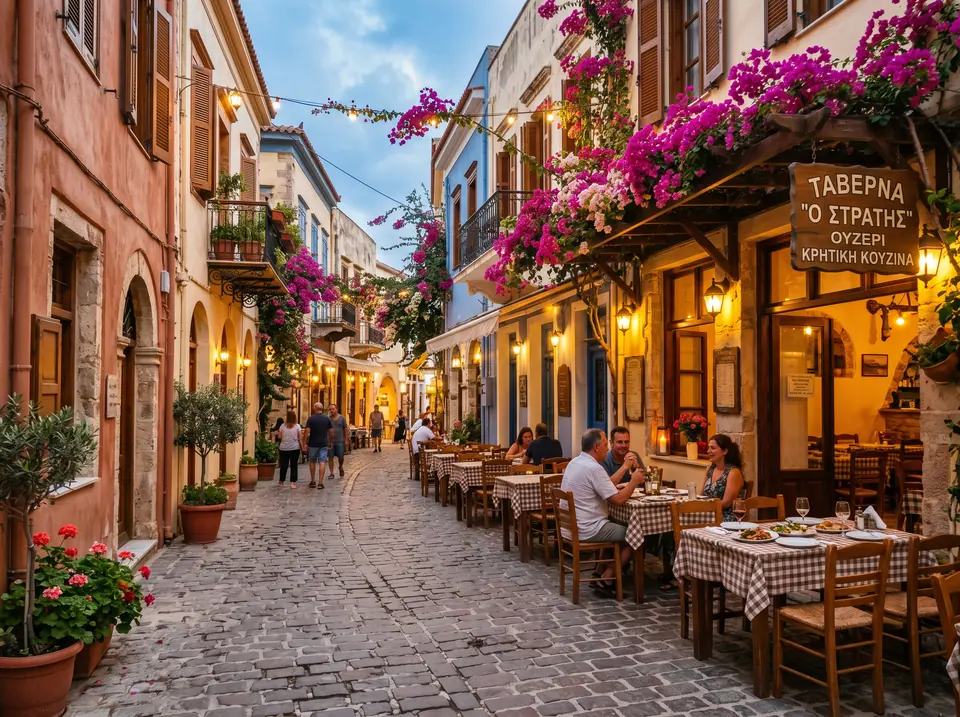
Late morning. Walk the Venetian quarter without a route. Winter is the only season you can do this properly — the lanes of Topanas and the Jewish quarter are genuinely empty, doors and courtyards are visible rather than screened by crowds, and the Venetian and Ottoman layering of the architecture is easier to read. Accept that a share of the shopfronts will be shuttered.
Lunch, long. This is the centrepiece of the day, not an interruption to it. Head into Splantzia or the streets behind the market rather than the harbour, and look for a full room. Winter menus lean towards slow-cooked meat, pulses, wild greens and baked dishes — see the Cretan winter table for what to order.
Dusk. The harbour, around 17:00. Winter light on wet stone, the lighthouse at the end of the breakwater, and almost nobody on the promenade. If a storm has just passed, the sea against the outer mole is genuinely dramatic. Then a bar in Splantzia — the nightlife guide covers which stay open off-season.
Day 2 — Inland, Where Winter Is the Season
The counter-intuitive day, and usually the best one. Crete's interior is at its most alive in winter: it is green rather than parched, the olive harvest runs from November into January, and the villages are inhabited by people rather than day-trippers.
An olive mill or a winery. Winter is the working season, which makes a visit genuinely interesting rather than a staged tasting — mills are pressing, and the new oil is the year's event. Wineries in the Chania hinterland stay open year-round and are quiet. Our wine and countryside tours page covers the operators; in winter, call ahead rather than turning up.
A village lunch. Therisso, up its gorge road south of the city, is the classic short run from Chania — a dramatic drive and a village of tavernas at the end. The Apokoronas villages east of town are the gentler alternative. Both are half an hour from the Old Town.
You need a car for this day. Winter buses do not serve these routes. See renting a car in winter — it is the cheapest hire of the year, and the roads here stay clear even when the high passes do not.
The Inland Day Is a Car Day
Therisso, the Apokoronas villages, the mills and the wineries are all a 20–40 minute drive and none are on a winter bus route. Off-season rates are the lowest of the year, and a single day's hire covers the whole of Day 2. If you would rather not drive after a wine tasting, a guided countryside tour solves the same problem.
Day 3 — Air First, Then Indoors
Morning. Take whatever weather you are given and get outside early. The Akrotiri peninsula paths are twenty minutes from the Old Town, low, coastal and walkable in almost anything — the monastery routes at Agia Triada and Gouverneto are the reliable choice. If the day is clear and you have longer, Imbros Gorge is the winter gorge walk.
Afternoon. Back into town for the indoor half: the Archaeological Museum, the Maritime Museum in the Firkas bastion, and the Venetian arsenals along the eastern harbour. None takes long, all are near each other, and all are pleasant in bad weather.
Before you go. Back to the market for oil, thyme honey, graviera and mountain tea — winter is when the good oil is new, and it is the one souvenir from Crete genuinely worth the luggage weight.
If It Rains the Whole Weekend
It can. Chania averages its heaviest rainfall in December, and a three-day trip can catch a genuinely wet run. The weekend still works, but the shape changes: more market, more museums, longer lunches, and the acceptance that the harbour walk happens in a raincoat and is better for it.
The indoor list is longer than people expect — the covered market, three museums, the arcaded lanes, olive-oil and wine tastings inland, and the simple fact that a four-hour lunch in a room with a fire is not a fallback but a legitimate way to spend a winter afternoon in Greece. What does not survive a wet weekend is anything on a boat or a beach, and in winter those were not options anyway.
Where to Stay for a Winter Weekend
Stay in the Old Town, and preferably in the western half around Topanas or near the market. The reasoning is entirely practical: in winter you want the distance between your room and dinner to be short, and you want to be able to retreat when a squall arrives and come back out twenty minutes later.
Two things to check that do not matter in summer: heating, which is genuinely variable in old Venetian buildings, and whether the property is open at all — a share of small Old Town hotels close for the winter. Rates for those that stay open are a fraction of the summer price. Our where to stay guide covers the neighbourhoods; hotels covers specific properties.
Winter Rates, Old Town Location
Off-season, an Old Town room costs a fraction of its August price — which makes the location upgrade nearly free, and in winter the location is the whole point. Filter for properties confirming heating, and check the dates are actually bookable rather than assuming year-round opening.
Frequently Asked Questions
Is 3 days enough for Chania in winter?
Three days suits Chania better in winter than in summer. The summer trip is stretched across the island — Balos, Elafonissi, Samaria, all long days out — and three days cannot hold it. In winter those are closed or impractical anyway, leaving the Old Town, the market, the food and one inland day. That is genuinely a three-day trip rather than a compressed week.
What is there to do in Chania when it rains?
More than the beach reputation suggests. The covered Agora is indoor by definition. The Archaeological Museum, Maritime Museum and Venetian arsenals all work in bad weather. The Old Town's covered lanes let you wander with only short exposed stretches. Long lunches in tavernas with fireplaces are the local answer and the right one. And an olive mill or winery inland is an indoor activity at its most interesting in winter, because that is the working season.
Are restaurants open in Chania in winter?
Many are; a meaningful share are not. Chania is a real city, so places serving locals stay open year-round — Splantzia and new-town tavernas, the market cafés, the bakeries. What closes is the seasonal layer: harbourfront restaurants built for summer trade, and small places taking the winter off. Eat where locals eat rather than on the waterfront — better advice in any season, unavoidable in January.
Is Chania Old Town nice in winter?
Arguably at its best. The Venetian harbour without cruise-day crowds, wet stone reflecting the lights, the lighthouse against a dramatic sea, and lanes you can walk rather than shuffle along. The trade-off is that a portion of the businesses lining those lanes will be shuttered — quieter and emptier as well as more beautiful.
More winter planning: Winter in Crete hub · What to eat in winter · Winter hiking · Winter car hire