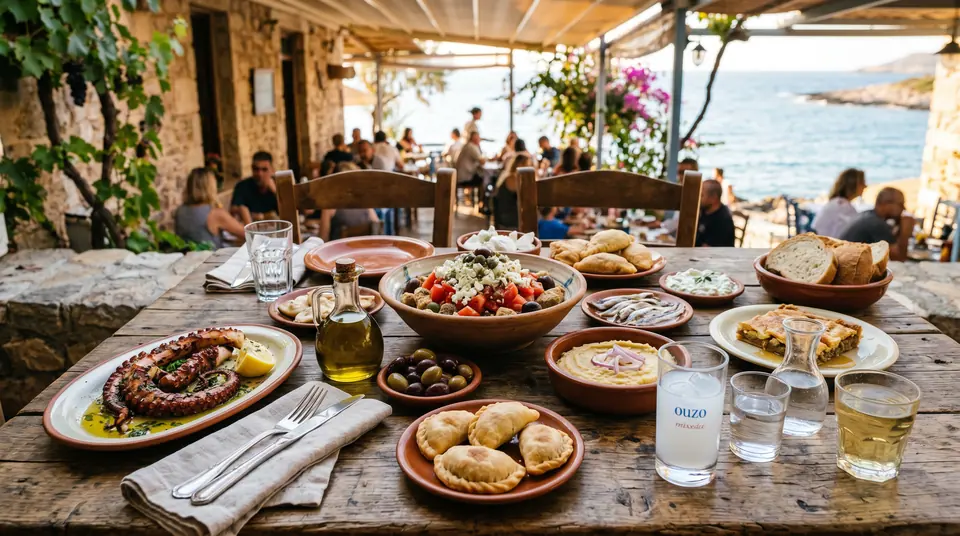
The short version: a half-day group class runs €75–95pp and gets you dakos, a hand-rolled pie, a slow-cooked vegetable dish and the meal at the end. Vamos, 25km south-east, is the strongest setting and usually includes transport. Old Town market-to-table classes are the easiest to fit around a city day. Private kitchens start near €150pp but drop sharply per head for four or more. Book a week ahead in July and August.
The Three Kinds of Class
Search "cooking class Chania" and you get a list that looks interchangeable. It is not. There are three formats and the difference between them is bigger than the difference between operators within each one.
- Market-to-table, in or near the Old Town. Starts at the covered Agora, where you shop for what you are about to cook, then walks to a kitchen nearby. Best if you are without a car, short on time, or want the market explained as part of the day. Typically 5–6 hours including the shopping.
- Village classes, mostly Vamos and the Apokoronas. A restored stone kitchen, a garden or small farm attached, and a slower pace. Usually includes transport from Chania if you ask. The best version of the experience if you have the half-day. Around 6 hours door to door.
- Private, in a family kitchen. One group, one host, and the menu bends to what you want to learn. The most expensive per person at small numbers and the best value at four or more. Often inland, in villages the coast road never shows you.
See what is running on your dates
Cooking classes near Chania run small — six to ten people on a group class — so availability is the real constraint rather than price. Live availability and current prices for all three formats:
What They Cost
Prices below are 2026 guide figures and move with season and group size. Every format includes the food you make; most include wine or raki with the meal.
| Format | Typical price | Length | Best for |
|---|---|---|---|
| Market-to-table, Old Town | €75–95 pp | 5–6 hrs | No car, city-based trips |
| Village class, Vamos / Apokoronas | €100–130 pp | ~6 hrs | The full experience |
| Private family kitchen | from ~€150 pp | 4–6 hrs | Groups of 4+, dietary needs |
| Food tour (for comparison) | €90–140 pp | 3–4 hrs | First few days in Chania |
The thing worth knowing before you compare on price: a class is a meal as well as an activity. You will not want dinner afterwards, which quietly takes €25–40 a head off the real cost.
What You Actually Cook
Menus shift with the season because the good operators buy that morning, but the core is consistent:
- Dakos — barley rusk, grated tomato, mizithra, oil, oregano. Assembly rather than cooking, but the rusk-softening is where people go wrong at home.
- Kalitsounia — small hand-rolled pies, cheese or wild greens. This is the part everyone remembers, and the part that needs a person standing next to you.
- A slow vegetable dish — briam, gemista, or beans. Cretan cooking is far more vegetable-led than most visitors expect.
- Something with graviera — the hard sheep's cheese from the mountains behind Chania.
- Horta — wild greens, boiled and dressed with oil and lemon. The dish that most defines everyday Cretan eating and the one nobody thinks to ask about.
- Thyme honey, usually with something fried, to finish.
If a listing names a fixed menu with no seasonal note, that is a small warning sign. Ask what changes in May versus September; the good ones have an answer.
Why Vamos Comes Up So Often
Vamos is a restored village roughly 25km south-east of Chania in the Apokoronas, and it has been running visitor cooking classes longer than almost anywhere on the island. The reason it dominates the listings is not marketing — it is that the village kept its stone kitchens and its working agricultural surroundings, so the class happens somewhere that makes sense rather than in a hotel demonstration room.
It is a half-day out from Chania. Most operators include transport, but confirm it rather than assuming: a taxi each way turns an €110 class into a €160 one. If you are driving anyway, it pairs well with Lake Kournas, which is fifteen minutes further on.
Class or Food Tour?
This is the actual decision most people are making, and the honest answer is that they do different jobs.
The walking food tour is the better introduction. Three to four hours, eight to twelve tastings, the Agora and Splantzia explained, and you finish knowing what you like. The cooking class is the better souvenir — slower, narrower, and you leave able to make four or five dishes at home.
With a week in Chania, do the food tour in the first couple of days and the class later in the trip. With three days and one slot, take the food tour: it covers more ground and it will change where you eat for the rest of the trip. Our Chania food guide covers what to eat if you would rather do neither.
Doing both?
The food tour early and the cooking class later is the order most people should use — you learn what you like before you commit a half-day to making it.
Booking and Timing
Book ahead. Group classes run at six to ten people. July and August departures commonly fill a week out; May, June, September and October usually need two or three days.
Off-season is on request. Between November and March many operators run only when they have numbers. Message first rather than planning a day around a listing.
Say what you don't eat when you book, not on the day. Cretan cooking is unusually easy to make vegetarian and has a genuine native vegan tradition in the fasting-day dishes — nistisima — rather than substitutions. Gluten is the harder ask, since the rusks and pies are the centre of it.
Go early in the trip if you are self-catering. Everyone leaves a class wanting to cook, and the Agora is far more useful once you know what to do with what is on the stall.
Frequently Asked Questions
How much does a cooking class in Chania cost?
Roughly €75–95 per person for a half-day group class, including ingredients, the cooking, the meal you make and usually wine or raki. Village classes that add transport from Chania and a farm or garden element run nearer €100–130. Private classes start around €150 per person and fall sharply per head as group size rises, so for four or more they are often comparable to a group class.
What do you cook in a Cretan cooking class?
Almost always a spread rather than one dish. The common core is dakos, a hand-rolled cheese or greens pie (kalitsounia), a slow-cooked vegetable dish such as briam or gemista, and something with the local graviera. Better classes add horta — wild greens — and finish with something sweet in thyme honey. What you make shifts with the season, because the good operators shop the Agora that morning rather than working from a fixed menu.
Where are cooking classes near Chania held?
Three broad settings. In Chania Old Town or just outside it, usually paired with a walk through the covered Agora first. In Vamos, a restored village about 25km south-east in the Apokoronas, where several long-running operators use traditional stone kitchens. And in family homes and small farms in the villages inland, which is where the private classes tend to be. Most village options include transport from Chania if you ask when booking.
Is a cooking class better than a food tour in Chania?
They answer different questions. A food tour is the better introduction — three to four hours, eight to twelve tastings, more ground covered for slightly more money. A cooking class is the better souvenir, because you leave able to make four or five dishes at home. With a week in Chania, do the food tour early and the class later, once you know what you actually like.
Do cooking classes in Chania cater for vegetarians and vegans?
Yes, and Cretan cooking suits it unusually well. Much of the traditional repertoire is naturally vegetarian, and the Orthodox fasting calendar means there is a deep native vegan tradition — nistisima — rather than a set of substitutions. Flag it when you book so the shopping accounts for it. Gluten is the harder ask, since the pies and rusks are central.
Do you need to book a Chania cooking class in advance?
Yes. Classes run with small numbers — often six to ten people, and the private ones by definition one group — so July and August departures commonly fill a week ahead. In May, June, September and October two or three days is usually enough. Out of season many operators run only on request.
Are cooking classes in Chania good for children?
Generally yes, and better than most restaurant meals, because there is something to do. Pie-rolling and pastry work suit children well. Check the minimum age when booking — some classes involve knives and hot ovens and set a floor around eight, while private classes usually adapt to whoever turns up.
How long does a Cretan cooking class take?
Four to five hours for a typical group class including the meal — the cooking itself is around two hours and the eating is not rushed. Classes that begin with a market walk run five to six hours. Village classes with transport from Chania are effectively a half-day out, so plan around six hours door to door.
More on eating here in our Chania food guide and best restaurants in Chania. For everything else bookable, see Chania tours — or tours with pickup included if you are not driving.