Disclosure Some links on this page are affiliate links. If you book through them we earn a small commission, at no extra cost to you — it is what keeps this guide free and independent. How we make money.
The short version: Crete is 260 km long and the commonest first-itinerary mistake is treating it as a small island. In seven days, use two bases, not five — five nights around Chania for the west, two around Rethymno on the way east, or stay put in Chania the whole week and accept you will not see Knossos. A hire car is essential for this route. Packing and repacking every night is how people come home tired.
The Mistake Most Itineraries Make
Crete is 260 kilometres end to end — about the distance from London to Manchester, on roads that are frequently much slower. It is the fifth-largest island in the Mediterranean and it does not behave like a small Greek island.
The classic seven-day plan found online moves every night: Chania, then Rethymno, then Heraklion, then Agios Nikolaos, then back. It looks efficient on a map and is exhausting in practice. You spend the mornings packing, the middles of days driving, and the evenings finding somewhere to eat in a town you have not learned yet.
Two bases. One move. That is the shape that lets a week feel like a holiday.
The Shape That Works
| Days | Base | What it buys you |
|---|---|---|
| 1–5 | Chania | Old Town, Balos, Elafonissi, Falassarna, Samaria, the south coast |
| 6–7 | Rethymno | A second Venetian town, a shorter hop to Knossos, a different coast |
If you would rather not move at all, stay in Chania for all seven and drop the Knossos ambition. That is a good week too, and our 5-day Chania itinerary covers the tighter version.
Book the car at the same time as the first hotel
Peak-season car supply in Crete tightens well before accommodation does, and automatics go first. Local operators include full insurance with no excess, which matters on these roads.
Days 1–2: Chania
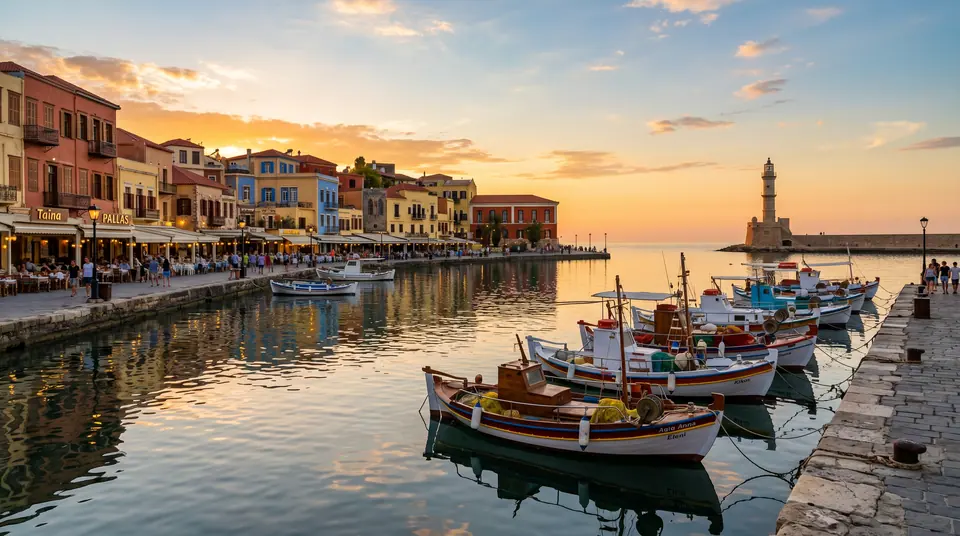
Day 1 — arrive, collect the car (or don't yet; see below), and do nothing ambitious. The Old Town deserves an unhurried evening: the Venetian harbour, the walk out to the lighthouse, dinner two streets back from the water rather than on it. Our restaurants guide names the places worth finding.
Day 2 — the Old Town properly by daylight: the covered market, the Splantzia quarter, the arsenals, the maritime museum if the weather turns. Afternoon at Nea Chora, which is a sandy beach eighteen minutes' walk from the harbour and the easiest swim of the week.
A note on the car: parking near the Old Town is genuinely awkward. Many people pick the car up on day 3 rather than day 1 and save themselves two days of it.
Day 3: The West
The big one. Two choices and they are both good.
Balos and Gramvousa by boat from Kissamos — turquoise shallows, a Venetian fortress island, and the most photographed view in Crete. The boat trip is the sensible way in; the overland track is excluded by nearly every hire-car contract.
Elafonissi — the pink-sand lagoon, about 90 minutes each way on winding road. Flatter, easier, better for small children, and busy by eleven. Go early.
Both in one day is possible on paper and a bad idea in practice.
Day 4: Samaria or Sfakia
If you walk: the Samaria Gorge. Sixteen kilometres, one way, downhill, finishing at Agia Roumeli on the south coast where you leave by boat and then bus. It is a full and genuinely tiring day, and for a lot of people it is the thing they remember about Crete. Book the organised transfer — the logistics are the product.
If you don't: drive south to Chora Sfakion and Loutro. Loutro has no road at all and is reached by boat, which is precisely why it is worth the trip — a white village on a bay with nothing to do but swim and eat. The drive over the mountains is one of the best on the island.
Day 5: Beach Day
Whichever of Balos or Elafonissi you skipped on day 3, or Falassarna — a long golden west-facing beach that does the best sunset in Crete and is far less trouble to reach than Balos.
Alternatively, take the day off the road entirely: a wine afternoon in the hills, a cooking class, or Lake Kournas with a pedalo. After four days of driving, a slow day is worth more than another beach.
Days 6–7: East to Rethymno
Day 6 — check out, drive an hour east on the national road, and spend the afternoon in Rethymno: a third Venetian old town, a very large fortress, a long sandy town beach and a good, cheaper food scene. Our comparison covers how the two towns differ.
Day 7 — either Knossos, now a much more reasonable hour and a quarter away rather than two hours; or Preveli and the palm-lined river gorge on the south coast; or Arkadi Monastery inland, which matters a great deal in Cretan history and is quiet in the morning.
Fly home from Heraklion rather than Chania if your flights allow — it saves the whole drive back west.
If You Want It Different
No car. Stay in Chania all week and use organised trips — our no-car guide lists what is genuinely reachable, and it is more than people expect.
With young children. One base, shorter drives, the family guide has the beaches with shallow water and the practicalities.
Beach-led. Drop Samaria, add Seitan Limania and the Akrotiri beaches, and spend the second half of the week in the far west around Falassarna.
Ten days rather than seven. Add a third base further east — Agios Nikolaos or Elounda — and Spinalonga becomes realistic. At a week it does not.
Off-season. Winter in Chania is a different and much quieter trip; several of the days above depend on boats that do not run.
Practicalities
- Fly into Chania, out of Heraklion if you can. Open-jaw saves you a two-hour drive and one-way car hire between the two is straightforward — see the one-way guide.
- Book Samaria and the Balos boat ahead in July and August. Both sell out and both are fixed-date.
- Budget one long driving day, not four. If your plan has more than one two-hour leg, it has too many bases.
- Late September is the best week of the year for this route — warm sea, thin crowds, lower prices. Month by month has the detail.
- Costs — what a week actually comes to, broken down by tier.
One Week in Crete: FAQ
Is one week enough for Crete?
Enough for one half of the island properly, not for all of it. Crete is about 260 kilometres end to end and the interesting roads are slow, so a week spent trying to cover everything becomes a week of driving punctuated by brief stops. The satisfying version of seven days is to pick a half — west from Chania, or east from Heraklion — and go deep. Most first-time visitors are better served by the west, which has the best-looking town and the most famous beaches.
Should you stay in one place or move around in Crete?
Two bases is the sweet spot for a week. One base means a couple of long driving days to reach the far sights; three or more means you spend a meaningful part of your holiday packing, checking out, driving and checking in again. Two gives you a settled first half and a change of scene for the second, with only one moving day. If you would rather not move at all, staying in Chania for the full week is a perfectly good trip, simply with a shorter reach.
Do you need a car for a week in Crete?
For this itinerary, yes. Buses connect the main towns along the north coast perfectly well, but the beaches, gorges, villages and viewpoints that make Crete worth a week are not on those routes or run once or twice a day. Without a car you can still have an excellent time based in Chania using organised day trips, which our no-car guide covers — but the route on this page assumes you are driving.
Can you see Knossos and Chania in the same week?
Yes, but it costs you most of a day. Knossos sits just south of Heraklion, which is about two hours from Chania each way on the national road. As a day trip from Chania that is four to five hours of driving for a ninety-minute site. It works much better if you are moving east anyway — breaking the journey at Rethymno and continuing to Heraklion on another day — or if you simply accept that a west-coast week does not include it.
What is the best base for a week in western Crete?
Chania, without much competition. It has the most beautiful old town on the island, the best food, the airport, and it sits within reach of Balos, Elafonissi, Falassarna, the Samaria Gorge and the south coast. Rethymno is the natural second base if you are moving east — it is roughly halfway, has its own Venetian old town and fortress, and shortens the drive to Heraklion considerably.
How much driving is a week in Crete?
On this route, one long day of around two hours in each direction, two or three days of roughly an hour each way, and two days with almost none. That is a reasonable balance. Itineraries that add Agios Nikolaos, Elounda or the far east to the same week roughly double the driving, and it is worth being honest with yourself about whether you enjoy that or merely tolerate it.
When is the best week to do this itinerary?
Late September is close to ideal: the sea is at its warmest after a summer of heating, the crowds have thinned, prices have dropped and the gorge is comfortable to walk. May and early June are the other strong window, with wildflowers and cooler walking but slightly cooler water. July and August work but the heat makes the gorge harder and the famous beaches considerably busier.
Related planning: the 5-day Chania itinerary if you are staying west the whole time, day trips from Chania for the full menu, and the south coast road trip if you would rather cross the island than run along it.