Disclosure Some links on this page are affiliate links. If you book through them we earn a small commission, at no extra cost to you — it is what keeps this guide free and independent. How we make money.
The short version: a villa in Chania makes financial sense from roughly six adults upwards and is usually the wrong call for two. The best-balanced stock is in Apokoronas — Vamos, Gavalochori, Almyrida, Kalyves — with Akrotiri closest to the airport and Old Town. Budget for cars, not a car: villa country has no walkable anything. And check three things the listings gloss over — air conditioning in every bedroom, whether the pool is heated if you are travelling outside June to September, and what the last few hundred metres of road are actually like.
The Maths: When a Villa Wins
Almost every argument about villas is really an argument about group size, and it resolves quickly once you do the division.
A villa is priced per property, per week. A hotel is priced per room, per night. That difference is the whole story. Two people in a four-bedroom house with a pool are paying for two bedrooms they will not open and a pool they would have had for free at a resort. Ten people in the same house are splitting a fixed cost ten ways while a hotel would have charged them for five rooms.
The crossover in the Chania market usually lands somewhere around six adults. Below that, rooms generally win. At eight to ten, a villa is normally well clear — and the gap widens again once you count the meals. A family of eight eating breakfast out every day and dinner out every night in Platanias in August is spending a serious amount of money that simply does not get spent when there is a kitchen, a supermarket in Vamos and a barbecue on the terrace.
The honest test takes two minutes. Take the villa's total for your dates, including cleaning and any pool heating, divide by the number of paying adults, divide again by the nights, and compare that number against a real per-person room rate for the same dates. Do not compare against the cheapest room in Chania; compare against the room you would actually have booked.
One thing that number will not capture, and which is often the real reason people choose a villa: with a group, a villa gives you somewhere to be together in the evening. Ten people in five hotel rooms end up in a bar. Ten people in a house end up around a table. If that is what the holiday is for, it is worth paying a premium for, and you should say so out loud rather than pretending the spreadsheet made you do it.
See what villas are actually going for on your dates
Rates in the Chania hinterland swing enormously between July and May, and the only useful comparison is one with your own dates and headcount in it. This pulls live availability across the booking sites at once.
Where the Villa Stock Actually Is
This is the part most people get wrong, because they start from "Chania" and expect villas near the Old Town. There are a handful, they are expensive, and they mostly have no pool and nowhere to park. The real inventory is inland and east, and it divides into four areas with genuinely different characters.
Apokoronas — the default answer
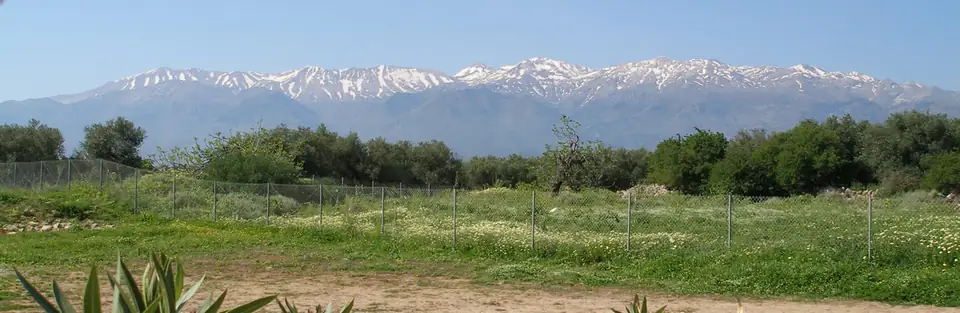
The rolling green country east of Chania, between the Souda bay coast and the northern foothills of the White Mountains. This is where most of the good villa stock in the region is, and for a first villa trip it is the obvious place to start looking.
Vamos is the anchor village — a proper working village with a square, a bakery, a doctor, a supermarket and several genuinely good tavernas, restored rather than rebuilt. Gavalochori is smaller, quieter and prettier still. On the coast, Almyrida and Kalyves give you shallow, safe swimming and a strip of waterfront tavernas, and Plaka sits on the hillside above with the views. Villas here tend to be stone-built conversions or modern houses in olive terraces, almost all with private pools.
The practical case for Apokoronas is balance: the airport is 30 to 40 minutes away, Chania is about 25 minutes, Rethymno is around 40, and you are ten minutes from a beach and five from a taverna. It is green rather than arid, which matters in August. What it is not is nightlife, and it is not walkable in the sense of stepping out of your door into a town.
Check what is available around Vamos and Almyrida →
Akrotiri — closest to everything
The peninsula north-east of the city, with the airport on it. Akrotiri is the shortest transfer of any villa area — often fifteen minutes from the terminal — and the quickest run into the Old Town for dinner, which makes it the best pick if you want the city regularly rather than occasionally.
The landscape is drier and more open than Apokoronas: low scrub, big sea views, monasteries, and the beaches at Seitan Limania, Marathi and Stavros. Villas cluster around Kounoupidiana, Chorafakia and Stavros. The two things to weigh are aircraft noise, which is real in some spots and non-existent a kilometre away, and the fact that it is browner — if your mental picture is green hills, Akrotiri will surprise you.
Check villa availability on Akrotiri →
Inland from Platanias and Kolymbari — sea views and the strip
Up in the hills behind the resort coast west of the city, villages like Maleme, Gerani and the slopes above Kolymbari carry a good stock of villas with long views over the sea. The draw is having the Platanias strip ten minutes downhill — supermarkets, restaurants, bars, water parks, everything a family needs on tap — while sleeping somewhere quiet.
The catch is the descent. These are hillside villages, the roads down are narrow and switchbacked, and "ten minutes to the beach" is ten minutes of concentration each way. It is also the area where the drink-driving arithmetic bites hardest, because the tempting restaurants are all at the bottom of the hill.
Check villas above Platanias and Kolymbari →
The far west — cheapest, remotest, different
Beyond Kissamos, out towards Falassarna and the Gramvousa peninsula, villa rates drop noticeably and space opens up. You are close to the best beaches in the region and to Balos, and a long way from everything else — Chania is 45 minutes to an hour, and a forgotten shopping item is a genuine expedition.
This is an excellent choice for a group that wants to be beach-based and self-sufficient, and a poor one for anyone planning to hop between the city, the gorges and the south coast. Stock is thinner, so book earlier.
Check villas in the far west →
The Car Is Not Optional
Worth stating plainly, because it is the single most common villa mistake: the thing that makes a villa nice is the same thing that makes a car compulsory. The pool, the privacy, the view and the silence all come from not being in a town. There is no walk to a supermarket, the taverna is three kilometres away downhill, and rural bus services in Apokoronas and the Akrotiri villages run to a school and market timetable rather than a holiday one. Taxis exist but are not hailed — they are phoned, and they are not cheap from a village at midnight.
Two consequences people underestimate:
- A group of eight usually needs two cars, not one. One vehicle cannot take four people to the beach and collect the late arrivals from the airport simultaneously, and a week of negotiating who gets the car is a poor holiday. Two small cars are also frequently cheaper than one seven-seater, and far easier to park and to turn round on a village lane.
- Somebody is not drinking. Greek drink-drive limits are low and enforcement around the resort areas is real. In a villa, dinner out means a designated driver every single night, which is precisely why so many villa groups end up cooking most evenings — and why the barbecue and the kitchen are worth more in the listing than the second bathroom.
Book the cars at the same time as the villa, not after. Peak-season car supply in Crete tightens well before the accommodation does, and in July and August the automatics go first. Our Chania car rental guide covers the local operators, the insurance traps and the airport-versus-town pickup question, and automatics gets its own page because of how scarce they are.
Two small cars usually beats one big one
Local Cretan companies include full insurance with no excess and no card block as standard, which matters when you are hiring two vehicles rather than one. Prices are per car, per day — compare before you commit to a seven-seater.
Pool Realities
The pool is usually the reason for the villa, and it is the part of the listing worth the most scepticism.
Heating. Most private pools in Crete are unheated. That is perfectly fine from roughly mid-June to late September, when the sun does the job. In April, May and October an unheated pool is cold enough that children will get in twice and adults will not get in at all — so if you are booking a shoulder-season trip largely because of the pool, you need to establish whether heating exists, what it costs, and whether it has to be ordered in advance. It commonly runs to a meaningful weekly supplement and often needs 24 to 48 hours to bring the water up, so it is not something to decide on arrival.
Fencing and gating. Greek rental villas are not generally required to fence their pools, and most do not. If you are travelling with toddlers, assume open water a few steps from the living room unless the listing explicitly says otherwise, and ask for photographs of the pool surround rather than of the pool.
Shade and orientation. A pool terrace with no shade is unusable between one and four in July. Look for a pergola, mature trees or an umbrella in the photographs; if every photo is taken at golden hour, that is sometimes why.
Privacy. "Private pool" means yours, not unoverlooked. In hillside villages the house above can see straight down into it. If that matters to you, the satellite view of the address will answer the question faster than the owner will.
Shared pools. Plenty of properties advertised in villa searches are one of three or four units around a shared pool. That can be excellent value and is a perfectly good holiday, but it is a different product from a private house — read the property type, not the headline.
Eleven Things to Verify Before You Pay
Villa bookings are less standardised than hotel bookings, and the deposit is usually non-refundable, so the questions are worth asking by message before anything leaves your account. Keep the replies — a written answer is what you will need if something is not as described.
- The last few hundred metres. Ask directly whether the access road is surfaced the whole way. A meaningful number of rural Cretan villas are reached by an unmade track, which is uncomfortable in a small hire car, occasionally impassable after rain, and — importantly — often excluded by the rental company's insurance. Ask for a photograph of the driveway.
- Air conditioning in every bedroom. Not "air conditioning" as a tick box. Count the units against the bedrooms, and ask whether running it is included or metered.
- Actual sleeping arrangements. "Sleeps ten" frequently includes a sofa bed in the living room and a child bed in a box room. Ask for the bed configuration room by room, and confirm which doubles are genuinely doubles rather than twins pushed together.
- The security deposit. How much, taken how — cash on arrival, a card pre-authorisation, or a bank transfer — and returned how and when. Cash deposits in euros on arrival are still common and worth knowing about before you land.
- Changeover day and check-in time. Many villas are fixed Saturday-to-Saturday or Sunday-to-Sunday in peak season, which constrains your flights rather than the other way round. Check-in is often 16:00 or later with a hard 10:00 checkout, and a late-evening arrival needs arranging in advance.
- Cleaning and linen. Whether the final clean is included or added, whether there is a mid-week clean and change of towels on a long stay, and whether pool maintenance visits happen while you are there (they usually do, and that is normal).
- Water and power in August. Rural Crete runs on tanks and, in places, on wells. Ask whether the property has a tank, how big it is, and what happens if it runs low — an eight-person household uses water at a rate a couple never does.
- Wi-Fi, honestly. If anyone needs to work, ask for a speed test screenshot rather than a yes. Hillside villages vary wildly, and mobile coverage in the folds of Apokoronas is patchy. Our eSIM guide covers the backup plan.
- Terrain and steps. Villas on olive terraces are built on slopes. Ask how many steps there are between the parking and the front door, and between the house and the pool, if anyone in the group has knees, a buggy or luggage they cannot carry.
- Noise sources. Village churches, roosters, dogs, the cicadas and — on Akrotiri — flight paths. Ask what is audible at night. Nobody minds a rooster they were warned about.
- Who to call. Whether there is a local manager or keyholder on the island and how quickly they attend. This is the single biggest difference between a well-run villa and a badly-run one, and it costs nothing to ask.
Villa vs Hotel vs Apartment
Three different products, and the right one depends more on group size and on what you want your evenings to look like than on budget.
| Private villa | Hotel / resort | Apartment | |
|---|---|---|---|
| Works best at | 6–12 people | 1–4 people | 2–5 people |
| Priced | Per house, per week | Per room, per night | Per unit, per night |
| Car | Essential — usually two | Optional | Helpful, not essential |
| Evenings | Everyone together at home | Out, or in the bar | Either |
| Pool | Private, often unheated | Shared, sometimes heated | Shared or none |
| Effort | You run a house | None | Some |
| Old Town at night | Taxi or designated driver | Walk, if you stay central | Walk, if you stay central |
| Book ahead | 6–9 months for peak | 2–3 months | 2–4 months |
| Where to look | Apokoronas & Akrotiri | Our hotels guide | Old Town & Nea Chora |
If you are still deciding between areas rather than between property types, our neighbourhood guide is the better starting point, and the hotels page covers the room-by-room options by area and budget.
Costs Beyond the Nightly Rate
The headline weekly price is rarely what you pay, and villa extras are less standardised than hotel extras. Budget for:
- The cars. Two vehicles for a week in August is a real line item, not a rounding error, and it is the cost most often left out of the villa-versus-hotel comparison.
- The final clean. Sometimes included, sometimes a separate charge, occasionally substantial on a large house.
- Pool heating, if you need it, typically charged weekly and ordered in advance.
- The security deposit, which is not a cost but is money you need available on arrival, often in cash.
- The first shop. Stocking a villa kitchen from empty for eight people is a substantial supermarket trip on day one — do it on the way from the airport rather than doubling back the next morning.
- Air conditioning, where it is metered rather than included.
- The tourist tax, charged per night by accommodation type and normally collected on arrival.
None of these change the conclusion for a group of ten. They can quietly change it for a group of five, which is exactly the size where the decision is close.
When a Villa Is the Wrong Choice
Worth being direct about, because plenty of people book one and then spend the week wishing they had not.
Two or three of you. You will pay for empty rooms and drive everywhere. Book a room in the Old Town and walk to dinner.
Nobody wants to drive. A villa holiday with one nervous driver on hairpin village lanes is a week of low-grade stress, and our no-car guide exists precisely because that is a real preference worth designing around.
A short trip. Under four nights, the transfer, the shop and the settling-in consume a disproportionate share of the holiday. Villas reward a week.
You want the Old Town at night. Chania's evenings — the harbour, the backstreet tavernas, the bars off Splantzia — are one of the best things about the place, and they are much better when your bed is a ten-minute walk away rather than a twenty-minute drive with a sober driver. See the Old Town guide for what you would be commuting to.
You want to be looked after. A villa means shopping, cooking, loading a dishwasher and taking the bins out, in the heat, on holiday. Many people love exactly that. If you do not, no amount of infinity pool will fix it.
Where to Book, and When
Villa inventory in Chania is spread across the big rental platforms, a handful of specialist villa agencies, and direct-booking owner sites — and the same house frequently appears on several of them at different prices. It is worth a comparison search rather than booking the first listing you like, because the spread on an identical property can be significant.
Timing matters more than it does for hotels. There is exactly one of each villa. A hotel that is busy sells you a different room; a villa that is booked is simply gone. For July and August with fixed dates and a fixed group, six to nine months ahead is normal, and the best properties in Apokoronas go in January and February. Outside peak, the pressure collapses — six to eight weeks is usually plenty, and late September and May throw up genuinely good prices on houses that were unobtainable in August. If you have flexibility, those two months are when a villa is most obviously worth it, with the pool caveat above.
Whenever you book, get the eleven answers above in writing first.
Compare villas across the booking sites at once
The same property often appears on several platforms at different rates. This searches them together for your dates and headcount, so you can see the spread before you commit a non-refundable deposit.
Villas in Chania: FAQ
Is a villa in Chania cheaper than hotel rooms?
It depends almost entirely on how many of you there are. At two people a villa is nearly always the more expensive way to sleep in Chania, because you are paying for a whole house and a pool you did not need. The crossover is usually somewhere around six adults, and by eight to ten a villa is normally well clear of booking the equivalent number of hotel rooms — especially once you count the breakfasts and the dinners you now cook at home. Divide the total by the number of paying adults and compare that with a per-room rate for the same dates, and the answer stops being a matter of opinion.
Do you need a car to stay in a villa in Chania?
In practice, yes, and you should treat it as part of the price rather than an optional extra. Almost all of Chania's villa stock is rural or semi-rural — the reason it has a pool and a view is that it is not in a town — so there is no realistic walk to a supermarket, a taverna or a beach, and bus services in the hinterland are built around school and market runs rather than visitors. A group of eight usually needs two cars, not one, because one vehicle cannot be at the beach and the airport at the same time.
Where are the best villas in Chania?
The densest concentration of good villa stock is in Apokoronas, the green rolling country east of Chania around Vamos, Gavalochori, Almyrida, Kalyves and Plaka — close to beaches, well supplied with tavernas, and about 30 to 40 minutes from the airport. The Akrotiri peninsula is the other strong area, and the closest to both the airport and the Old Town. Inland from Platanias and Kolymbari gives you sea views and proximity to the resort strip. The far west beyond Kissamos is the cheapest and the most remote, and is a genuinely different holiday.
Are villa pools in Crete heated?
Most are not. An unheated pool in Crete is delightful from roughly June to September and bracing on either side of that, so if you are travelling in April, May or October the pool you are paying for may go almost unused unless it is heated. Heating is usually an optional paid extra rather than something that runs by default, it often has to be requested before arrival, and it can cost a meaningful amount per week. If the pool matters for a shoulder-season trip, confirm in writing that heating is available, what it costs and how long it takes to bring the water up.
What should you check before booking a villa in Crete?
The access road, first — a surprising number of rural villas are reached by an unsurfaced last few hundred metres, which matters for a small hire car and can affect your insurance. Then air conditioning in every bedroom rather than just the living room, whether the pool is fenced or gated if you have small children, the size and steepness of the terrain if anyone has mobility problems, the changeover day and whether it is fixed, what the security deposit is and how it is taken, whether linen and a mid-stay clean are included, and how the water and power supply behave in August. Ask by message before paying, and keep the replies.
When is a villa the wrong choice in Chania?
When there are only two or three of you, when nobody wants to drive or drink-drive rules will spoil the evenings, when you are staying under four nights and the drive and the shop will eat most of it, when you actually want the Old Town at night rather than a twenty-minute taxi from it, and when you want somebody else to do the cooking and cleaning. A villa is a house you are running. If the appeal of the holiday is not having to run a house, book rooms.
How far in advance should you book a villa in Chania?
Earlier than a hotel room, because the supply is genuinely finite — there is exactly one of each villa, and the good ones for July and August are often gone by January or February. If you are travelling in peak season with a fixed group and fixed dates, six to nine months ahead is normal and not paranoid. Outside July and August the pressure drops sharply and six to eight weeks is usually plenty, with real bargains appearing in May and late September.
Do Chania villas have air conditioning?
Most do, but not always in every room, and that distinction matters more in Crete than almost anywhere. A listing can truthfully say air conditioning when the units are in the living room and the master bedroom only, which in August leaves whoever drew the short straw sleeping badly for a week. Count the units against the bedrooms before you book, and check whether running the air conditioning is included or metered separately, because some owners charge for it.
Is Apokoronas a good place to stay in Crete?
It is the best-balanced area in the Chania region for a villa holiday. Apokoronas is green and rolling rather than arid, it has real villages with year-round life at Vamos and Gavalochori, safe swimming and a run of tavernas at Almyrida and Kalyves, and it sits roughly midway between Chania and Rethymno with the airport 30 to 40 minutes away. It is not where to go for nightlife or for a walkable town holiday, but for a group with cars and a pool it is the obvious first place to look.
Deciding between areas rather than property types? Start with our where to stay in Chania guide. For rooms rather than houses, the hotels page goes area by area with prices. If the group includes children, Chania with kids covers the beaches and the practicalities, and car rental is the page to read next whichever villa you pick.